Sairat and the banality of violence

What makes ‘Sairat’ realistic is the forthright manner in which it highlights the routine violence of caste and patriarchy.

Have we ever bothered to think why the tragedies of Delta Meghwals and Rohith Vemulas fail to enter the mainstream public imagination? What discourse constructs our world of realities where the inhuman tragedies that continue to perpetrate the horrors of caste and gender violence fail to even attract sympathy, let alone bringing those involved in committing these heinous crimes to punishment? Rather, the mainstream public sphere is characterized by a consistent invisibilizing and negation of the violence that emanates from caste and patriarchal structures. Nagraj Manjule’s latest film, Sairat, is a cinematic intervention against such constructions of reality and compels us to look beyond what meets the eye.

Those who have seen Manjule’s debut film Fandry would remember the iconic climax where the protagonist Jabya flings a stone with full vigor towards the camera, as if it were aimed at the audience. Sairat is perhaps a reminder that the stone that Jabya threw at us in Fandry is not sufficient to demolish the structures of caste and patriarchy. Sairat highlights that fact that incidents of caste and gender atrocities are recurring events and a reality that one often chooses to ignore, consciously or otherwise.

Archi- Sairat’s female protagonist- is a daughter of the local MLA and her access to the pleasures of affluence are made abundantly visible through her powerfully crafted character. Archi’s character transgresses the norm of the submissive, shy ‘heroines’ in mainstream Indian films. Manjule, while circumventing these clichés, gives a great deal of agency to Archi’s character and boldly marks her desires. Manjule also highlights that the bravado that Archi exhibits is not accessible to other female characters in the film. Archi’s ability to transgress into a strong female character is enabled by a patriarchal structure of power that she inhibits as a daughter of the local MLA belonging to the dominant caste. In a scene where Archi drives a tractor and stops at the male protagonist Parshya’s house, Parshya’s mother looks at Archi and says, “You drive tractor like a man”. Upon looking at Archi, Parshya’s mother’s face is marked by an expression that is simultaneously in awe of Archi for driving a tractor and aware of the realities that confine her or her daughter within the boundaries of their lower caste female subjecthood. This moment reminded me of the gruesome events that took place in Khairlanji a decade ago where four members of the Bhotmange family belonging to a Dalit caste were murdered by the members of politically dominant Kunbi caste. The women of the family, Surekha and Priyanka, were paraded naked in public and later hacked to death by mutilating their bodies. One of the many things that had attracted the ire of the Kunbis was the fact that Priyanka dared to ride a bicycle to school while her mother Surekha had fought for retaining the ownership of her own piece of land. It is the same unholy collusion of patriarchy and caste that ‘allows’ Archi to ride a Royal Enfield while simultaneously  making Priyanka Bhotmange a victim of caste violence in Khairlanji for riding a bicycle. Manjule’s brilliance lies in how routinely he highlights this difference just by the subtle expression on the mother’s face, bereft of any melodrama that one has come to associate with mainstream Indian cinema.

In a scene towards the second half of the film, Manjule crafts another such moment that succinctly captures the core of the film. Archi’s father has to surrender his candidature to Sonal Tai, a female colleague in his party. This surrender on the father’s part, as we are made to understand, is a result of the ‘shame’ that Archi has brought to him and his family by eloping with a boy from lower caste. Earlier in an opening sequence, the father is shown criticizing the opposition contestant suggesting that since the opposition leaders cannot ‘control’ the ladies of their own family they are unfit to rule the constituency. One can not help but notice the blow his male ego has received from two women with aspirations, his daughter Archi, and Sonal Tai. The shot closes with a decisive look on the father’s face that is linked with the climax of the film that, like in Fandry, leaves the viewer shaken and speechless.

The daily violence of caste and patriarchy is often invisiblised in the mainstream public discourse, including films. Manjule’s films, inspired by the Ambedkarite discourse, forcefully draw attention to these routine acts of violence in a layered manner compelling the audience to take note of the same. Underneath Sairat’s narrative as an epic love story lie the banal realities of violence of both caste and patriarchy. Sairat, and Fandry are reminders that we need to open ourselves to these lived realities of the society that we inhibit, whose denial otherwise validates our comfort zones.

This was first published in The Goan on 9 May 2016. 

Cantaram as political dissent

Earlier this month, Goa Government’s Department of Information and Publicity held a ‘Konkani Kantaram Utsav’, a cantaram singing competition in which the participants were asked to sing about the achievements of the current Bhartiya Janata Party (BJP) government. This competition attracted a lot of criticism, noticeably from the tiatr community, questioning the government’s intentions behind organizing such a competition. Cantaram competitions are usually held without any pre-decided themes and certainly not with a rule that prohibits participants from criticizing the government. On the contrary, one of the several requirements of a cantar and cantorist is that of political sharpness. Cantoristsranging from Conception-Nelson-Anthony (famously known as the Trio kings) and William de Curtorim in the past, to the current sensation Francis de Tuem, have been famous for their radical political positions.Cantaram carry a huge affective magnitude for the Goan Catholic communities and it has played a key role in influencing public opinion at various historical junctures in post-colonial Goa.  The concerned department, in its official press release, stated that “[s]ong and drama is one of the medium used to propagating various policies, programmes and the schemes of the Government [sic]”. While using traditional cultural practices to propagate government schemes is not unheard of, there is more to the said cantaram competition than meets the eye.

11754510_905717512811034_6447163134040975280_oCantaram are an indispensable part of the tiatr, a theatre form that is popular largely among the bahujan Catholic communities in Goa. Audio CDs of cantars have brisk sales across Goa and is one of the most consumed form of Konkani music. In digital space too, acantar shared on YouTube would have an average of 25,000-30,000hits, a popularity that no other Goan cultural form enjoys. But the potency of cantar form lies in how, over the years, it has become a medium of formulating a discourse about the Catholic communities in Goa, wherein they retain their own agency.Cantaram, beyond its appeal as a form of entertainment, are employed to narrate and remember Goa’s history from the perspective of bahujan Goan Catholics. For instance, it would be helpful to look at two Goan political leaders, Dr. Jack Sequeira and Dayanand Bandodkar and their respective portrayal in cantaramand popular history. The popular narrative of Goan history escalates Bandodkar as a leader of masses while Sequeira’s role in Goan politics is inadequately discussed. But in cantaram, one finds an inversion of this narrative where Sequeira is celebrated for his definitive role during the Opinion Poll in 1967 while Bandodkar is subjected to sharp criticism for wanting to merge Goa with Maharashtra.

Such popular commentary on the state of Goa, emerging from a marginalized community poses a significant discursive threat to the regimes in power. Almost a year ago, the current BJP led government was exploring possibilities of setting up a censor board on tiatrs. However, the popularity that tiatrenjoys in Goa is far too powerful for the censors. Following a backlash over this move, the BJP government had to retract its decision. Having burnt their fingers once, this time the BJP led government saw it fit to organize a cantaram competition, with a clause that no adverse remarks could be made on the government, effectively imposing the censorship.

While the BJP draws its support largely from its anti-minority rhetoric in rest of the India, such stance hasn’t proven to be a success in Goa. In fact, any political outfit in Goa cannot afford to neglect the bahujan Catholic voters that until recently, could make or break governments. This is not to reduce the bahujan Catholic communities in Goa merely to a vote bank but to point to their acute political awareness, which marks them distinctly from the rest of the Goan population. The manner in which the Indian state has been rendering the Goan Catholic communities as dispossessed citizens, for example, by the denial of official recognition to Romi Konkani or the recent uproar over state grants to English medium primary school, makes them confront the state machinery in a manner which often proves to be litmus tests of Indian democracy in Goa. Cantaram and tiatr are central to the production and distribution of the discourse that makes this political awareness among the bahujan Catholic communities possible. By organizing the Cantaram Utsav, the BJP government precisely wanted to seek control of that discourse.

However, the tiatr community almost boycotted this event as a mark of protest. A collective that identifies itself as “Musical Warriors” gave a clarion call to Tiatrist and cantorists to gather outside the competition venue for a parallel cantar singing competition. This competition aimed at bringing forth the truth about the last four years of BJP governance and their anti-people policies and schemes. Singers Francis de Tuem, Lawry Travasso, Marcus Vaz among others, gathered outside the competition venue and singing critiques of the BJP-led Goa government in a sharply satirical cantar titled ‘Acche Din Aane Waale Hai’. This performative protest was sheer brilliance on the part of these singers to indicate that they will not compromise their political position for state patronage. While one fears that cantaramwould lose its radical potential owing to attempts of appropriation by the state such as the said Kantaram Utsav, the tiatr community, through this protest kept alive the tradition of political dissent.

Opinion Poll: Choice or Compromise?

We need a nuanced historical analysis to understand the preconditions and after-effects of the Opinion poll.

A series of events are being planned to commemorate the historic Opinion Poll whose  50th anniversary was marked last week on 16th January. Second to the territory’s merger into the Indian Union, the Opinion Poll is perhaps one of the most significant events in the history of post-colonial Goa. The Opinion Poll was a referendum held to decide whether to retain the Union territory status of Goa or merge it with the neighboring state of Maharashtra. The majority of Goans voted against the merger and thus Goa retained its status as a Union territory, putting an end to any possibility of the merger with Maharashtra.

Current tellings of the history of the Opinion Poll are centered around two prominent figures, Dayanand Bandodkar, the then chief minister, and Dr. Jack de Sequeira, the leader of opposition. While on the one hand it was Bandodkar’s Maharashtrawadi Gomantak Party (MGP) that rooted for the merger with Maharashtra in post-colonial Goa, on the other it was Dr. Sequeira and the United Goans Democratic Party (UGDP) who mobilized the anti-merger sentiments successfully. But such a reductive understanding of a complex historical moment ensures that the grey areas that marked Goa’s history and the reasons which prompted as well as averted the possibilities of merger are obscured. Recent historical analysis, such as that contained in Parag Parobo’s book India’s First Democratic Revolution (2015), hint  that Bandodkar was not keen on merger after he tasted political success. Also, the initial demand for merger dates back to late 40s, much before Bandodkar came onto the political scene. Hence to nuance our understanding of the Opinion Poll, we need to shift away from the sources that only emphasize Bandodkar and Sequeira, and write a history from below.

I was recently recounted an anecdote of a volunteer conducting the proceedings of Opinion Poll in Curtorim. After the polling ended in the evening, the said volunteer visited a nearby cafe where he overheard a conversation between two Catholic gentlemen. One of them reportedly proclaimed that “if Goa gets merged with Maharashtra, I will not stay in Goa anymore. I will move to Bombay”.

It might seem ironic that, in order to escape the threatened merger with Maharashtra, he wanted to escape to a city that was now claimed to be an integral part of Maharashtra. The city of Bombay had become the capital of the newly formed state of Maharashtra in 1960. However, if we assume that it was not so much the merger with Maharashtra that the gentlemen wanted to escape, but the possibility of further marginalization in a Hindu dominated polity his claim begins to make more sense. For him, the cosmopolitan big city would have perhaps offered hope to escape Hindu dominance. But since the late ’60s, spurred by the logic of linguistic nationalism that organized Maharasthra as a Marathi state cosmopolitan Bombay was also transforming to become the migrant hating ‘Mumbai’ claimed by the far right Hindu outfit Shiv Sena.

This situation illustrates how marginalized groups are compelled to compromise in order to negotiate their existence with a larger dominant community. Such compromises often come in the guise of political choices wherein, despite making a choice, the marginalized is destined to suffer. The Opinion Poll was one such compromise disguised as a ‘choice’. Whether to merge with Maharashtra or to remain as a Union territory were restricting choices. The Indian union never offered Goan citizens the possibilities of self determination. Instead, it obliged them to negotiate their political future within the narrow frames of Indian nationalism. This nationalism, which in hindsight has revealed itself as, in fact, Hindu nationalism has steadily led to the disenfranchisement of Goan Catholics as legitimate subjects of the republic. The recent berating of Catholics as lacking in Indianness due to their leadership of the demand for grants to English medium schools is evidence of such disenfranchisement

If the Goan Catholics wanted to escape Hindutva by voting against the merger, the Hindu bahujans wanted to escape Brahminical dominance by opting for the merger. In retrospect we realize that just as evading merger wasn’t a remedy to escape Hindu majoritarianism, merging with Maharashtra wasn’t a solution to escape the Brahminical dominance. To escape either of these evils, one must challenge the dominant discourse of Indian nationalism which is inherently infused with Brahminical Hindu notions.

It is only in hindsight that one can feel relieved that Goa did not merge with Maharashtra and was saved from being party to the hyper-masculine Maratha nationalism. However, Goa is far from escaping the ills of Hindu majoritarianism and has seen several native forms of Hindu majoritarianism breeding in the state. One can cite the movement for the official recognition of Konkani wherein the cultural legitimacy of Romi Konkani and the Catholic communities which utilized this script were systematically marginalized as lacking in Indianness as an instance of Hindu majoritarianism at work.

The Opinion Poll could be seen as a mixed blessing; a choice for freedom and independence that was structured upon narrow linguistic nationalism – thus restricting the very freedom and independence that it promised. While we celebrate Opinion poll as a triumph, we should also be aware that it restricted the lives of many Goans.

A response to ‘Archbishopancha Sermao’

An ideal commitment towards sustaining plurality would be to broaden the definition of ‘Indian’ness.

The Catholic communities in Goa have been at the receiving end of a vicious hate campaign spearheaded by the Bhartiya Bhasha Suraksha Manch (BBSM). BBSM’s vocal activist Naguesh Karmali recently made a statement saying that the ‘Church is worse than the Portuguese’, while Uday Bhembre urged the ‘75% majority population of Goa to rise up against the domination of 25% minority’. Reflecting on this hate campaign against the Catholic communities, Archbishop of Goa, at the annual Christmas civic reception held at his palace, remarked that newer forms of intolerance can be seen in the state today which are polarizing the majority against the minorities. In response to this speech by the Archbishop, the resident editor of Marathi Daily Lokmat, Raju Nayak, wrote a special editorial titled ‘Archbishopancha Sermao’ (Archbishop’s Sermon dt. 30th Dec. 2015) which claimed to analyze the Archbishop’s speech as well as the Church’s role in the crafting of Goa’s secular fabric.

Nayak’s first complaint was over the Archbishop choosing to address the gathering in English. Nayak writes that there was no need for the Archbishop to speak in English as, except for the Governor Mridula Sinha, the rest of the guests at the reception were Goans. Thus, Nayak feels that the Archbishop could have spoken in an Indian language or Konkani [sic] as it would validate the ‘Indian’ness of the Church in Goa. Nayak is implying that English isn’t Indian, a position that largely stems from the Hindu majoritarian discourse that accepts only upper-caste Hindu cultural forms as Indian, and regards the rest as foreign. Such parochialism slyly suggests that the Church (and hence Goan Catholics) are lesser Indians for not abiding by the expectations set by the Hindu majoritarian discourse.

Nayak claims that the Goan Catholics have been abandoning Konkani from their households. He alleges that the Archdiocese and the Diocesan Society were never in favor of imparting education in Konkani. They were instead compelled to convert their schools to Konkani medium as a result of the uncompromising position taken by the then Education minister Shashikala Kakodkar on giving grants only to primary schools with vernacular languages as the Medium of Instruction; and adds that schools run by Diocesan society and Archdiocese have killed Konkani education [sic]. But Nayak must remember that the Goan Catholic communities were jn the forefront of the people’s struggle during the official language movement. That were it not for the support of the Catholic clergy, right from the 1960s, the very idea of Konkani education would have been a dream. Despite all of this, the demand of the Catholics for granting of official status to Romi Konkani has not yet been realised. If the Hindu Brahminical leadership within the Konkani camp hasn’t been receptive to this demand of Goan Catholics, why should the Catholics now feel any commitment towards shouldering the burden of ‘safeguarding’ an Antruzi and Nagari-scripted Konkani that is in fact foreign to them? Rather, the existent pro-Nagri Konkani groups should be left on their own to safeguard the language which they concocted up for their own benefit.

Nayak further exposes his communal biases by arguing that the queues to avail Portuguese citizenship would compel anyone to conclude that English education is not only inadequate to create ideal citizens, but is also responsible for the sin [sic] of creating a generation of selfish and narrow minded individuals who have no sense of belonging towards the [Indian] nation. By Nayak’s logic, all English-learning Indian citizens will be regarded as anti-nationals. Why single out the Goan Catholics? Nayak further adds that the Goan Catholics are ‘disrespecting the core values that define Goa and are turning their back on the Indian nation’. According to a recent report published in Indiatimes.com (dt 28th Dec 2015), 65% of individuals who availed Portuguese citizenship were Catholics while 25% were Muslims and 10% were Hindus. These statistics show that though the majority of those opting for Portuguese citizenship are Goan Catholics, a significant number of Muslisms and Hindus too are availing the Portuguese citizenship. Moreover, the queues to obtain Portuguese citizenship are not Church-sponsored initiatives as Nayak seems to suggest, but are surely a product of the dominant Hindu nationalist discourse. If members of a particular community are surrendering their Indian citizenship at an average rate of 6 persons per day, accusing the entire community of turning their back towards the nation is not going to resolve the situation. Instead, one must also assess the implications of Hindu nationalism which treats non-Hindus as misfits within the Indian nation.

In essence, Nayak’s article suggests that to fashion oneself as Indian, one must abide by the diktats set by the Hindu majoritarian discourse. Such positions are not very different from the hardline Hindutva professed by far right groups such as RSS and VHP. Such a stance not only subjects the minorities under constant validation set by the majoritarian standards, it also denies the minorities the agency to make their own life choices. Nayak also expresses his concern over religious organisations posing a threat to Goa’s plural character. But by espousing the lines of soft Hindutva, Nayak seems to contradict with his concerns for plurality. Instead of berating Goan Catholics as unpatriotic, perhaps we need to broaden the definition of ‘Indian’ness to encompass cultures that are not necessarily Hindu.

Marathi and the Hindu Bahujans

Marathi is as much a carrier of Goan ethos as Konkani (both Romi and Nagari) and Portuguese.

The presence of Marathi in Goa is looked upon with suspicion by some for its links with the demand for Goa’s merger with Maharashtra from the period between 1961 until the Opinion Poll of 1967. In writing off Marathi as a Maharashtrian import, people often ignore the centuries-long historical presence of Marathi in Goa, as well as its current usage in the public sphere. Gauging by this usage, one can safely say that Marathi is as much a carrier ofthe Goan ethos as Konkani (both Romi and Nagari) and Portuguese.

The demand for Marathi as official language was largely made by the Hindu Bahujan Samaj of Goa initially, many of whom also identify with a Maratha identity. The Bahujan Samaj is a conglomeration of lower caste groups in Goa that was comprised of Kshatriya Maratha Samaj (Fisher communities), Gomantak Maratha Samaj (temple servants), Naik Bhandaris or Kshatriya Naik Marathas (toddy tappers), Kshatriya Komarpant Maratha (service caste) and Gaud Maratha (tribals). Following the rise of Maratha power in 17th century and Maratha invasions in Goa, Maratha identity had become a cultural resource through which lower castes imagined a modern identity, as Parag Parobo articulates in his book India’s First Democratic Revolution (2015). This reorganization of Hindu bahujan samaj in Goa around Maratha identity was aimed to contest brahminical hierarchy and social dominance.

The potency of the Maratha symbol for the bahujan samaj was further deepened in the course of the merger-language debates that dominated public discourse from the 1960s until their culmination in 1987. Recognizing that the pro-Konkani forces were in fact directed by Saraswat interests, the bahujan Hindus realized that the imposition of Nagari Konkani was a tool towards instituting Brahmin hegemony in Goa. It was for this reason that they chose to side with Marathi as their preferred language of expression. The political establishment in Goa was well aware of the emotional currency that Marathi carried for Hindu masses in Goa. Hence, there was a provision made to grant ‘equal status’ to Marathi in the Official Language Act of 1987 (OLA) and subsequently it was notified that Marathi would also be used in official purposes of the state government.

The suspicion of Marathi, especially among the Catholic communities in Goa, isn’t surprising. The merger with the Indian union in 1961 implied the arrival of Indian nationalist discourse in Goan public sphere which meant a preferential bias towards Hindus while Catholics would be rendered as second class citizens. The animosity of Catholic communities towards Marathi is precisely because of this reason and the Marathi camp in Goa did not make any attempts to address this problem. Instead the Marathi supporters further validated the apprehension that Goan Catholics harbored towards them by fashioning their demands of merger with Maharashtra and official recognition for Marathi with Hindutva symbolism.

But much has changed since the passing of Official Language Act, 1987. The Official Language Act did not give any recognition to Romi Konkani despite the fact that the mass support in favour of Konkani emerged from those who desired the recognition for Romi Konkani. If the demand for Marathi was seen as a bow towards a Hindu majoritarianism in Goa, instituting Nagari Konkani as the sole official language proved that suspicion right. One of the recurring argument made by the Nagari leaders against Romi Konkani was that the Roman script is ‘western’ and not ‘Indian’, and hence unfit for any official recognition. Secondly, they argued that the adoption of Nagari Konkani will help bring the Goan Catholics into Indian mainstream. What these two arguments not so subtly implied is that the Catholics in Goa would have to adopt the modes of life set by upper caste Hindus while rejecting the peculiar history that the Goan Catholics were part of. It is about time that Goan masses realize the brahminical agenda operating in the name of Nagari Konkani. The recent debate over the Medium of Instruction (MoI) issue is a direct result of this agenda and the failure of subsequent governments to amend the Official Language Act in order to make it more inclusive by giving equal status to Romi Konkani and Marathi.

The current Marathi leadership, however, is not positioned against countering the brahminical agenda operating via the Nagari Konkani camp nor do they seem to be interested in addressing the issues of caste tied with the assertion of Marathi in Goa. To make matters worse, the leadership within the Marathi camp is assumed by upper caste individuals who have suspicious links with right wing groups such as the RSS and VHP. What they will end up doing is to push down a brahminical Hindutva agenda on Hindu Bahujans. Also, the current Marathi movement, especially the one led by Marathi Rajyabhasha Prasthapan Samiti, is geared to oppose the alleged onslaught of English in Goa. Such a stance will curtail the possibilities of upward mobility to Hindu bahujans in a world that is dominated by English. An ideal assertion for Marathi in Goa would be one that recognizes the bahujan position of Marathi as well as that which employs Marathi as a gateway to learn English and access a world view beyond regional parochialism of Goa or India.

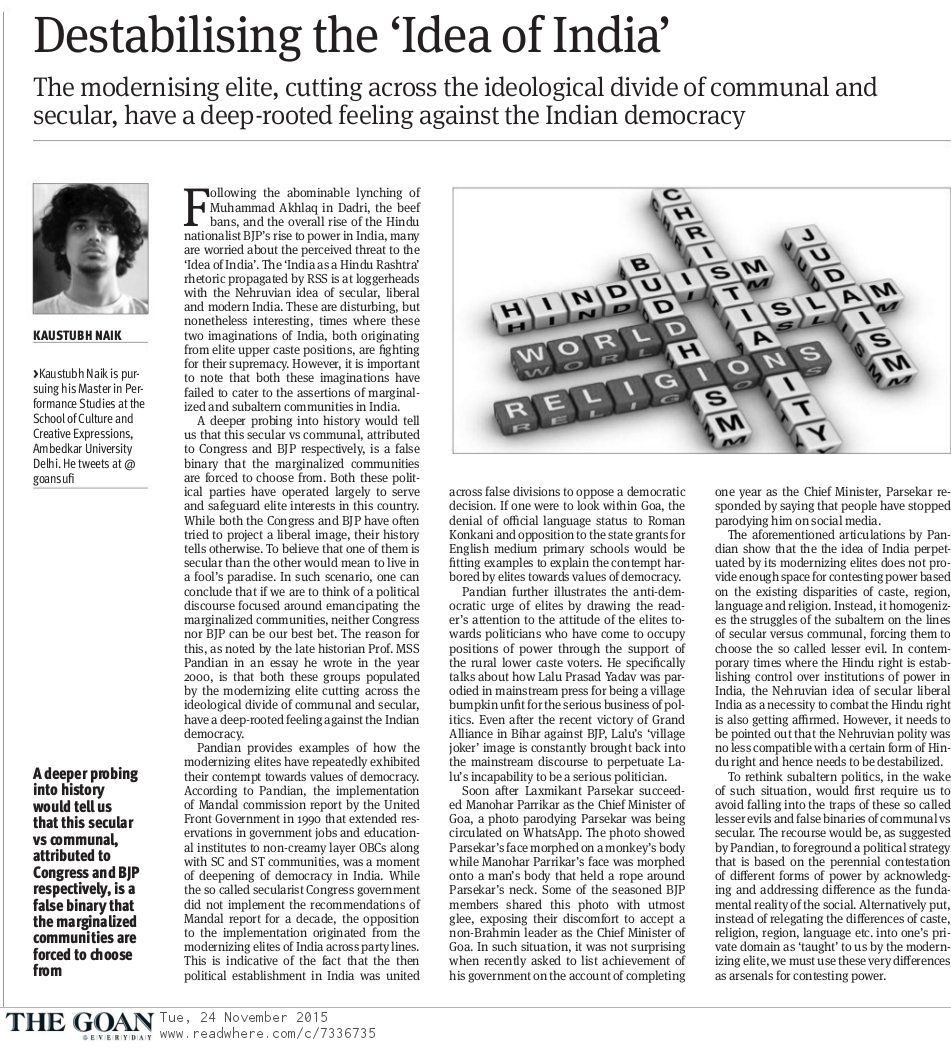
Destabilising the ‘Idea of India’

Following the abominable lynching of Muhammad Akhlaq in Dadri, the beef bans, and the overall rise of the Hindu nationalist BJP’s rise to power in India, many are worried about the perceived threat to the ‘Idea of India’. The ‘India as a Hindu Rashtra’ rhetoric propagated by RSS is at loggerheads with the Nehruvian idea of secular, liberal and modern India. These are disturbing, but nonetheless interesting, times where these two imaginations of India, both originating from elite upper caste positions, are fighting for their supremacy. However, it is important to note that both these imaginations have failed to cater to the assertions of marginalized and subaltern communities in India.

A deeper probing into history would tell us that this Secular vs Communal, attributed to Congress and BJP respectively, is a false binary that the marginalized communities are forced to choose from. Both these political parties have operated largely to serve and safeguard elite interests in this country. While both the Congress and BJP have often tried to project a liberal image, their history tells otherwise. To believe that one of them is secular than the other would mean to live in a fool’s paradise. In such scenario, one can conclude that if we are to think of a political discourse focused around emancipating the marginalized communities, neither Congress nor BJP can be our best bet. The reason for this, as noted by the late historian Prof. MSS Pandian in an essay he wrote in the year 2000, is that both these groups populated by the modernizing elite cutting across the ideological divide of communal and secular, have a deep-rooted feeling against the Indian democracy.

TheGoanDestabilisingIdeaofIndia

Pandian provides examples of how the modernizing elites have repeatedly exhibited their contempt towards values of democracy. According to Pandian, the implementation of Mandal commission report by the United Front Government in 1990 that extended reservations in government jobs and educational institutes to non-creamy layer OBCs along with SC and ST communities, was a moment of deepening of democracy in India. While the so called secularist Congress government did not implement the recommendations of Mandal report for a decade, the opposition to the implementation originated from the modernizing elites of India across party lines. This is indicative of the fact that the then political establishment in India was united across false divisions to oppose a democratic decision. If one were to look within Goa, the denial of official language status to Roman Konkani and opposition to the state grants for English medium primary schools would be fitting examples to explain the contempt harbored by elites towards values of democracy.

Pandian further illustrates the anti-democratic urge of elites by drawing the reader’s attention to the attitude of the elites towards politicians who have come to occupy positions of power through the support of the rural lower caste voters. He specifically talks about how Lalu Prasad Yadav was parodied in mainstream press for being a village bumpkin unfit for the serious business of politics. Even after the recent victory of Grand Alliance in Bihar against BJP, Lalu’s ‘village joker’ image is constantly brought back into the mainstream discourse to perpetuate Lalu’s incapability to be a serious politician.

Soon after Laxmikant Parsekar succeeded Manohar Parrikar as the Chief Minister of Goa, a photo parodying Parsekar was being circulated on WhatsApp. The photo showed Parsekar’s face morphed on a monkey’s body while Manohar Parrikar’s face was morphed onto a man’s body that held a rope around Parsekar’s neck. Some of the seasoned BJP members shared this photo with utmost glee, exposing their discomfort to accept a non-Brahmin leader as the Chief Minister of Goa. In such situation, it was not surprising when recently asked to list achievement of his government on the account of completing one year as the Chief Minister, Parsekar responded by saying that people have stopped parodying him on social media.

The aforementioned articulations by Pandian show that the the idea of India perpetuated by its modernizing elites does not provide enough space for contesting power based on the existing disparities of caste, region, language and religion. Instead, it homogenizes the struggles of the subaltern on the lines of secular versus communal, forcing them to choose the so called lesser evil. In contemporary times where the Hindu right is establishing control over institutions of power in India, the Nehruvian idea of secular liberal India as a necessity to combat the Hindu right is also getting affirmed. However, it needs to be pointed out that the Nehruvian polity was no less compatible with a certain form of Hindu right and hence needs to be destabilized.

To rethink subaltern politics, in the wake of such situation, would first require us to avoid falling into the traps of these so called lesser evils and false binaries of communal vs secular. The recourse would be, as suggested by Pandian, to foreground a political strategy that is based on the perennial contestation of different forms of power by acknowledging and addressing difference as the fundamental reality of the social. Alternatively put, instead of relegating the differences of caste, religion, region, language etc. into one’s private domain as ‘taught’ to us by the modernizing elite, we must use these very differences as arsenals for contesting power.

(First published in The Goan Everyday, dt: 24 November, 2015)

Subaltern Cultures as Commodities

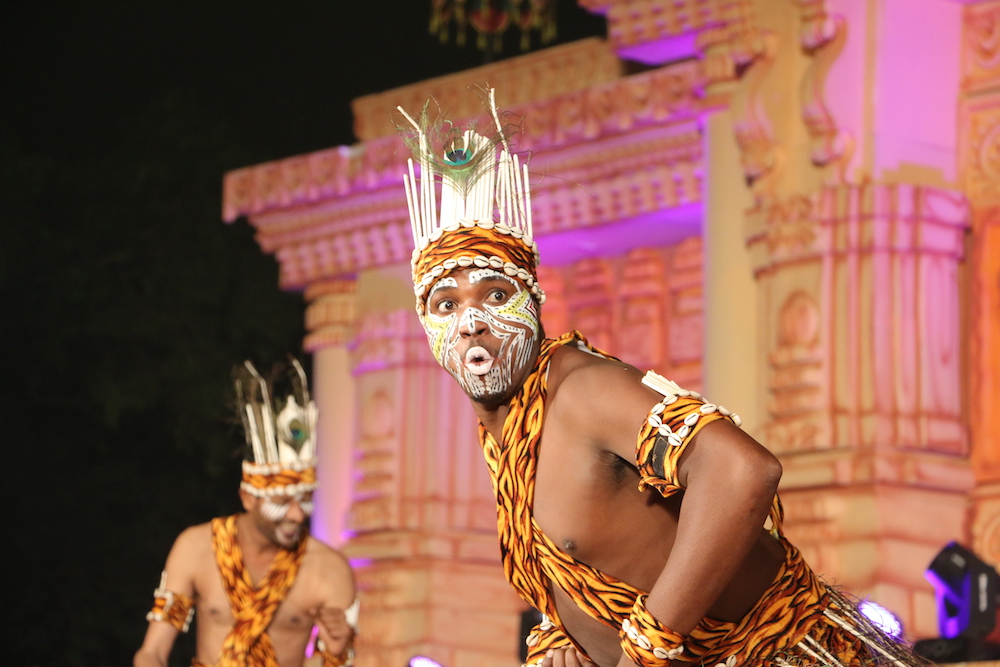
“Rashtriya Sanskriti Mahotsav”, India’s national cultural festival, concluded last week at the Indira Gandhi National Centre for Contemporary Arts (IGNCA) in New Delhi. This annual festival is organized by the Government of India’s Ministry of Culture in collaboration with its zonal cultural centers and various autonomous cultural institutions patronized by the state. The Ministry of Culture’s objective in organizing this cultural festival, as state on their website, is to ‘celebrate spirit of Tradition, Culture, Heritage and Diversity of our incredible country’.

The weeklong festival was host to performances from various parts of the country. In addition to these performances, each zonal center had set up stalls wherein handlooms and handicrafts from their respective zones were available for display and sale. Artists from various states took turns in showcasing their art forms and skills outside these stalls, while the metropolitan Delhi audience clicked selfies with these artists in background. These cultural festivals have become routine in the annual calendar of cultural events throughout the Indian metros. Supported by the State and Central Government’s Departments of Culture, these festivals invite troupes from various states to perform their ‘indigenous’ art forms for the pleasure of an urban audience. The aim of such festivals might be to provide exposure to various cultures of the country, but a closer reading allows us to unravel the curious relationship of the Indian nation with its subaltern cultures.

ncf2015image

Most of the art forms that are performed at such festivals fall under the category of folk arts and are practiced by the subaltern communities of the land. Unlike the classical art forms such as the Bharatnatyam or Kathakali in India, the folk arts do not claim their origins in Sanskrit texts such as the Natyashastra or Rigvedas. Instead, the folk art forms are inherently linked with the livelihoods of the communities practicing these arts. The cultural policies in India have rather successfully attempted to establish a hierarchy between classical and folk art forms, wherein folk art forms are ranked lower than the classical art forms. What this hierarchy suggests is that art forms which do not celebrate Sanskrit pasts are not worthy of being considered high art. The claims of these so called ‘classical’ art forms and their alleged origins in the golden age of Sanskrit is questionable and deserves an independent discussion.

This hierarchy between classical and folk arts implies different standards of remuneration and treatment to folk & classical artists, with classical artists being the pampered ones. The exclusionary attitude of the Indian state towards the subaltern art practices is further visible in the way in which the state promotes the folk and classical arts. To understand the biased attitude towards the folk arts, one could look at the festivals of classical arts organized by the state, such as the Khajuraho Dance festival or the Surashri Kesarbai Kerkar Classical Music Festival in Goa. These festivals of classical arts are organized as independent events and the name of each classical performer is individually publicized. On the other hand, the festivals of folk arts are organized along with handloom exhibitions, handicrafts sale and food courts, rendering them more on the lines of a chaotic bazaar instead of a cultural performance. Needless to say, the names of the artists performing these forms are never publicized, thereby reducing the folk artists to nameless & ahistorical bodies that merely perform a regional culture.

Most of these folk performances are associated with local rituals which are performed at specific times of the year and in specific spaces. By making the communities perform these art forms at these festivals that happen throughout the year, the organizers strip these art forms of their local context and convert them into cultural commodities that can be circulated for the consumption of an urban elite across Indian metros. The implications of this commoditization demands serious attention as it systematically alters the aesthetic structure of these forms in terms of costumes, duration of performance etc. It is not to say that the folk forms shouldn’t undergo changes in response to the times in which they are being practiced. In fact, changes in the art forms is what keeps them relevant in contemporary times. But these changes should occur organically within the community and not as a result of trying to fit them into a frame imposed by the cultural policies of the nation-state or because of global capital.

Taking cognizance of the aforementioned issues associated with cultural festivals that claim to celebrate folk cultures, one cannot help but see a strained relationship between the Indian nation and the subaltern communities. The subaltern communities are brought into mainstream spaces to exhibit their art and skills only when the nation seeks to celebrate its so called heritage and tired claims of unity in diversity. It is the same ‘Indian’ tradition, guided by casteist and communal doctrines, that otherwise ensures that these subalterns never become part of the mainstream. The benefits of the nation-state are not uniformly available to these communities on whose labor the nation validates its cultural existence. On the contrary, it appears that the Indian nation wants the subaltern communities to remain trapped in the bubble of their traditions, so that India’s post-colonial desperation of establishing a pre-colonial cultural identity can be fulfilled.

Dayanand Bandodkar, Ambedkar and Nehru

Bandodkar’s politics show the potential of Dr. Ambedkar’s vision, but also the limits of the Nehruvian model of governance.

In his essay titled ‘A Warning to Untouchables’, Dr. B.R. Ambedkar appeals to the depressed classes to strive for two goals. The first one being the pursuit of education and spread of knowledge, for he believed that the power of the dominant castes rested upon the lies consistently propagated among the uneducated masses. Challenging the dominance of the privileged classes requires countering these lies which could only happen with education. Secondly, he asserts that the depressed classes must strive for power. Ambedkar says that “[w]hat makes one interest dominant over another is power [and] that being so, power is needed to destroy power”.

The rise of the Bahujan Samaj Party under the leadership of Kanshi Ram and Mayawati in Uttar Pradesh from the mid 1990s is considered a success story of Ambedkar’s aforementioned appeals. But Parag Parobo’s recently published book, India’s First Democratic Revolution (2015), could help us imagine Goa’s first Chief Minister, Dayanand Bandodkar, as a bahujan leader whose politics resonated with Ambedkar’s political scheme mentioned above, much before Kanshi Ram and Mayawati.

TGE snap

In the first three state elections (1963, 1967, and 1972), the Indian National Congress (INC) suffered most humiliating defeats in Goa while Bandodkar and his Maharashtrawadi Gomantak Party single-handedly emerged as the most powerful political force. The reason for this, as cited by Parobo, was the INC’s dependence on reproducing feudal and caste hierarchies within the INC’s organizational structure. During the first Goa assembly elections in 1963, the INC gave candidature mostly to upper caste landlords and “freedom fighters”, leaving no space for the representation of subordinated castes. Bandodkar, on the other hand, placed an emphasis on giving tickets to the individuals belonging to the bahujan samaj, two significant examples being Kashinath Shetgaonkar, a loin-cloth-wearing farmer and Vijay Kamulkar, a tea-stall-owner, both from Pernem. Shetgaonkar and Kamulkar won their respective seats while defeating feudal doyens Raghunathrao Deshprabhu and Vaikunthrao Dempo. Deshprabhu and Dempo’s loss reflects the grit of the masses to reject the INC’s attempt to reproduce upper caste dominance within electoral democracy.

Bandodkar’s caste background not only informed his political strategy but also his vision. Parobo astutely elaborates on this aspect by analyzing Bandodkar’s educational policies for Goa vis-à-vis Jawaharlal Nehru’s educational policies for India. Nehru is uncritically considered as the architect of Modern India by a large majority of the Indian population. Nehru’s narrative of development was launched through investments in heavy industries and mega-projects and dams, which Nehru referred to as the ‘temples of Modern India’. However, as Parobo points out, Nehru’s development rhetoric emphasized higher education by downplaying the value of basic education in the country. At a time when a vast portion of the country’s population did not have access to basic education, Nehru made precious resources available to higher education in the process  starving primary and secondary schools of funds.

High resolution Image of book
Available for online order on Amazon

Parobo articulates it precisely when he writes that “at a time when investments in higher education were a priority being driven by [the] Nehruvian vision of India, Goa’s story was being scripted very differently”. Within one month of taking charge of the government, Bandodkar announced the setting up of 200 primary schools for the academic year 1964-65. The major thrust of his educational policy was to eradicate inequality by universalizing primary education and to make education accessible to everyone in Goan society by setting up educational institutions in villages, especially for those who belonged to lower ranks in the caste hierarchy. Under Bandodkar’s tenure, the number of primary schools increased from 274 to 492 in 1964-65 and further increased to 900 in 1967. According to Parobo, Bandodkar did not merely limit himself to opening up schools but also created conditions that would make Bahujan access to education possible. For example, Bandodkar’s land reforms liberated the low caste mundkars from feudal compulsions and responsibilities, thus easing their way towards acquiring education. The results of these concentrated efforts were seen in the census of 1971, wherein in the New Conquests, a region which had received relatively less attention in terms of education before 1961, the literacy rate increased from 18 to 51 percent.

Bandodkar seized political power which, according to Ambedkar, was the master key for the lower caste emancipation. Through his political strategies and reforms, Bandodkar was able to achieve two things. Firstly, Bandodkar disrupted the elite Goan establishment, both Hindu and Catholic, which was reaping benefits available to them through their support of the Portuguese colonial state. Secondly, he strategically rejected the INC’s hierarchical politics as well as the Nehruvian vision of development that catered to safeguarding the interests of the elites. Instead, he scripted a development narrative that prioritized the liberation of the lower caste communities. Thus, even though Bandodkar may not have engaged directly with Ambedkar’s political thought, he was able to demonstrate the potential of Ambedkar’s vision of subaltern emancipation. He did this by seizing political power and exposing the limits of the Nehruvian model of governance. This goes to show that a critical questioning of Nehruvian idea of ‘modern’ nation and coupling an inclusive version of Bandodkar’s strategy with Ambedkar’s political thoughts could help us to imagine possibilities of emancipating the subaltern in contemporary times.

When the Bahujans Speak

Porobo’s book on Bandodkar offers fresh perspectives on Goa by narrating a history that refuses to conform to the dominant narratives.

The discourse on Goa’s history oscillates between two dominant narratives, one is that of Goa Dourada –a reminiscence about a Goa that is European; and the second —Goa Indica– which is a nationalist reversal of Goa Dourada, at times propagated by orientalist scholars. Both are often pitted against each other, ultimately trying to erase the existence of the other narrative. However, both these narratives emerge from elite rungs of Goan society and hence fail to represent the complex nature of Goa’s diverse social ethos. The inadequacy of these narratives lies in the very nature of their historiography which tends to ignore or silence the marginalized communities of the land. Till recently, no scholarly attempts of writing ‘history from below’ were made in the context of Goa and the recently published book India’s First Democratic Revolution – Dayanand Bandodkar and the rise of the Bahujan in Goa (2015) by Parag Parobo is a step towards bringing marginalized  narratives of history to the fore. Parag Parobo is a professor of History at the Goa University.

High resolution Image of bookThe book chronicles the rise of Hindu Bahujan samaj in post-colonial Goa under the leadership of Dayanand Bandodkar. Moving away from the trend of solely attributing the Portuguese colonial state for the ‘making and unmaking’ of Goa, Parobo argues that Goa was a product of Portuguese as well British colonialism. Similarly, post-colonial Goa isn’t a self-standing entity but, he says, one needs to place Goa in wider context of the subcontinent while assessing its regional complexities. Adopting a non-conformist approach to the Portuguese colonialism, the book also debunks the trend to attribute Goa’s post-colonial advancements to the Portuguese colonialism, which fell considerably short of effectively reviving an economy that was stagnating economy since the nineteenth century.

The book begins by giving a detailed accounts of formation and consolidation of caste identities in Goa. The case of Gaud Saraswat Brahmins (GSBs) is of particular importance here to understand their dominance in contemporary civic sphere. The book argues that the Brahmin status of Saraswats is actually a seventeenth century construct, following the intervention of the Benares based Vedic scholar Gaga Bhatta. Porobo also critically analyses the myth of Parashuram as narrated in the Sahayadrikhand from the nineteenth-century, rebutting the antiquity of the claims therein. Thus, Porobo challenges a dominant view that asserts the GSBs as the original settlers of Goa, based on a nineteenth-century rendition of the Sahayadrikhand.

Simultaneously, Parobo also offers insight into the reorganisation of lower caste communities around the Maratha identity as a path to seek upward mobility. Further, the book analyses the colonial state in its local and micro contexts, unearthing the elitist nature of Portuguese colonialism. Parobo argues that the colonial state, and its collaboration with Saraswat Brahmins, actually accelerated the Brahminisation of Goa in terms of establishing control on land, temple, administration, and history.

In post-colonial Goa, Parobo provides a detailed account of Bandodkar’s politics and how his lower caste affiliation complimented with his capitalist background marked a possibility of emancipation for the Bahujan samaj in Goa. Parobo provides insightful analysis of the merger issue for which Bandodkar has been criticised by a certain fraction of Goan society even today. Parobo argues that, though the Maharashtrawadi Gomantak Party’s (MGP) chief agenda was to merge Goa with Maharashtra, Bandodkar wasn’t keen on the merger. He says Bandodkar’s personal political interest may have taken precedence over the party ideology. Even though the rest of the MGP wasn’t satisfied with the opinion poll verdict, Bandodkar was first to accept it. The opinion poll did not dent Bandodkar’s image but on the contrary, strengthened it. MGP’s vote base and seats increased in the elections that followed the merger. Parobo further analyses Bandodkar’s regime through his far reaching land reforms, educational policies and healthcare initiatives that proved to be emancipatory to the Bahujan samaj.

The book seeks to project Goa onto India to demonstrate how the marginalized, equipped with political power, can change the course of their progress and create newer possibilities for themselves. Nehru’s vision for India was a result of his upper caste elite background which worked only to the benefits of Indian elites while the marginalized struggled to find a place for themselves within that vision. Bandodkar, with his lower caste capitalist background, set a model of governance that prioritized liberating the Bahujans from bonds of feudal and social oppression. The limit of Nehruvian idea of development and liberating nature of Bandodkar’s governance is evident from Parabo’s astute analysis of their respective education policies.

The book departs from the traditional narratives of Goa Dourada and Goa Indica and reterritorializes Goan history from the perspective of the lower castes. However, its scope is limited to the Hindu Bahujans and the narrative of the subaltern Catholic is largely absent in this work. Also, the book does not provide an analysis of the progress of Bahujans post the Bandodkar regime, which was systematically hurdled by the resurgence of brahminical dominance in Goan civic sphere. The denial of official language status to Marathi or the recent amendments to the tenancy act are telling examples. Nevertheless, the book offers some great insights into Goa’s history and is a must read for individuals interested in understanding Goa as well for those engaged in articulating newer possibilities of subaltern politics in contemporary Indian context.

(The book is published by Orient BlackSwan under their “New Perspectives in South Asian History” series. The book is available for online purchase on Amazon)

Of Muthalik and Nagri Konkani

Goa’s multicultural ethos is threatened not just by Rama Sene, but from self-professed guardians of Konkani identity too.

The ban on entry of Pramod Muthalik’s Sri Ram Sene into Goa has now been extended till January 2016 by the Goa Government. Drawing attention to another sinister group engaged in cultural policing, last week, BJP MLA Vishnu Wagh urged the chief minister to impose a ban on Sanatan Sanstha for its alleged links with the murder of Govind Pansare in Kolhapur.  While Sanatan Sanstha was alleged to have been involved in the Margao blast case few years ago, Muthalik, who achieved national attention after his associates ransacked a pub in Mangalore in 2009, wanted to set up a Ram Sene branch in Goa.

Goa has been a target of these groups for the supposed ‘western’ outlook and character. Outfits like Ram Sene have stated their intentions to cleanse Goans of western influences. Such cultural imposition of right wing Hindu outfits must be resisted, though whether to ban them or not is a topic for another article. However, while it is important to be vigilant of these external forces altering plurality of Goan society, one must be aware of such culture police locally present within Goa. This local culture police might not be as formally organised as Ram Sene, but their larger project has similarities, i.e. to impose a singular identity by carefully erasing all cultural differences to ensure the hegemony of a dominant social group. It is also interesting to note that some of these individuals indulging in cultural policing are also active members of a Facebook group called “We Don’t Need Ram Sene in Goa”.

I am referring to the lobby that propagates Konkani as the authentic embodiment of Goan identity. The Official Language Act of 1987 instituted ‘Konkani written in Devnagari script’ as the sole official language of Goa. This Konkani, however, was not the extant and popular Concani. Rather, it was the dialect spoken largely by the Hindu Saraswats of Goa. By officially recognizing this Konkani as the only official language of Goa, the state excluded two major Goan communities i.e. the Catholic and Hindu Bahujan groups. The Catholics in Goa largely use the Roman script to write Concani. By specifically mentioning ‘Konkani written in Devnagari script’, the official language act slyly suggested that Devnagari script is the marker of ‘Indianness’ in Goa.

As Goan historian Parag Parobo suggests in his book India’s First Democratic Revolution (2015), the upsurge of Maratha power in 17th century had turned Maratha identity as a symbol of cultural resou rce. The lower caste Hindus in Portuguese Goa articulated  a modern identity through the Maratha symbol to escape caste oppression.  The potency of this symbol was further deepened in the course of the merger-language debates that dominated public discourse from the 1960s until their culmination in 1987. Recognising that the pro-Konkani forces were in fact directed by Saraswat interests, the bahujan realised that the imposition of Nagri Konkani was a tool towards instituting brahminical hegemony in Goa. It was for this reason that they chose to side with Marathi as their preferred language of expression.

The symbolic power attached to Nagri Konkani by its institutionalisation through the state apparatus has rendered Goan Catholics and Hindu Bahujans as ‘lesser’ Indians and Goans respectively. Instead, it frames the Nagri Konkani supporting Hindu as the ‘ideal’ representative of Goan identity. Such idealisation is in the interest of sustaining the caste hegemony of Saraswats in Goa. In the popular press or social media platforms, any demand for official status for Romi Konkani is vehemently opposed citing it as a representative of the colonial hangover of Goan Catholics. Similarly, even though the pursuit of merger is no longer feasible, the demand for official status for Marathi in Goa is held under suspicion as a step towards Goa’s merger with Maharashtra. Both these demands emerge out of a resistance to upper caste hegemony and are a call for accommodating the plurality of vernacular cultures in Goa. However, the ‘Nagri Konkani sena’ has time and again opposed such assertions by labelling them as a threat to “Goan identity”; implying that such identity should be expressed only through Nagri Konkani. Those demanding official status for Romi Konkani are asked to leave for Portugal. Similarly, those asserting a Marathi identity to resist Nagri Konkani hegemony are asked to settle in Maharashtra.

Muthalik and the Nagri Konkani lobby may have different organizational structures and modus operandi but they strive towards similar agenda. In the case of Muthalik, it is the militant imposition of Hinduism as the authentic Indian culture, by attacking cultures that challenge the idea of ‘Hindu rashtra’. In the case of the Nagri Konkani-wallahs, it is professing of Nagri Konkani as the sole vehicle of Goan identity. Any opposition to this is accused of being a ‘traitor’ to Goan and Indian society. Muthalik has often resorted to violent ways of propagating his claim while the Nagri lobby systematically executes its agenda through an equally violent, albeit insidious, state apparatus. Both consider themselves to be the guardians of monolithic identity formulations that are validated only by excluding the subaltern communities of the land. While there is no doubt that Goans need to be vigilant against the Ram Sene, there is clearly a need to challenge such locally present cultural policing as well.

(First published in The Goan Everyday dated 29th September 2015)